

A well-planned medical pendant system helps hospitals organise essential equipment, medical gas connections and electrical services around the patient. In operation theatres and intensive care units, where multiple devices may be required at the same time, a double arm medical pendant provides greater flexibility in equipment positioning and workspace management.
Unlike a fixed equipment column, a ceiling-mounted double arm pendant uses two movable arms to position the service head where clinical teams need it. This makes it useful in operating rooms, surgical departments, ICUs and other critical care environments.
For hospitals evaluating a double arm pendant manufacturer in India, the important considerations include arm movement, load capacity, medical gas configuration, electrical connections, safety features and compatibility with the room layout.
What Is a Double Arm Medical Pendant?
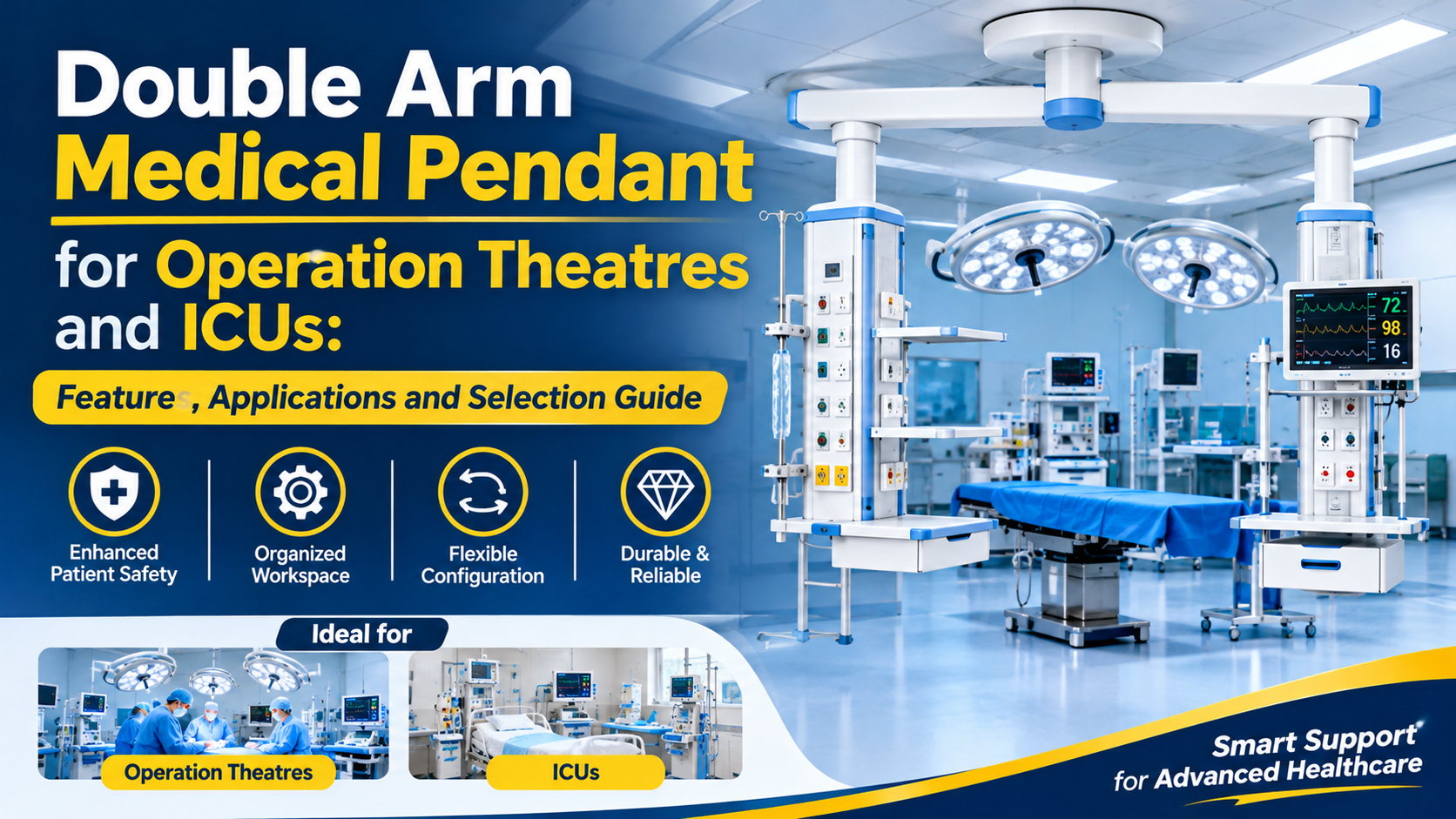
A double arm medical pendant is a ceiling-mounted equipment support system designed to bring medical gas outlets, power sockets and equipment accessories closer to the patient and clinical team. It consists of two connected movable arms and a terminal unit that can be positioned according to the requirements of the treatment area.
The two-arm arrangement offers a wider positioning range than a conventional single-arm system. Medical professionals can adjust the pendant to support different procedures while keeping cables, equipment and service connections organised.
Depending on the hospital's requirements, the terminal unit can accommodate:
- Oxygen, medical air and vacuum outlets
- Electrical power sockets
- Data and communication connections
- Equipment trays and shelves
- Storage drawers and accessory holders
- IV poles and other clinical accessories
The final configuration should be planned around the equipment used in the department and the services available in the hospital.
Why Do Hospitals Use Double Arm OT Pendants?
Operation theatres often require several medical devices to be positioned around the operating table. Anaesthesia equipment, patient monitoring systems, surgical instruments and other equipment must remain accessible without obstructing the surgical team's movement.
A double arm OT pendant helps address these requirements through adjustable positioning and organised service access.
Key advantages include:
Flexible equipment positioning: Two movable arms allow the terminal unit to be brought closer to the required working area. This is particularly useful when the equipment arrangement changes between procedures.
Better workspace organisation: Power cables, medical gas connections and accessories can be arranged around the pendant rather than spread across the floor.
Improved access to services: Medical gas outlets and electrical connections are available near the treatment area, reducing the need for separate service arrangements.
Adaptability for different procedures: The pendant can be configured with accessories suited to the hospital's surgical and anaesthesia equipment.
Efficient use of floor space: Since the system is ceiling-mounted, it can help reduce dependence on floor-standing equipment supports.
These benefits depend on correct installation, suitable configuration and appropriate equipment loading.
Applications of Double Arm Medical Pendant Systems
Double arm pendants are commonly considered for departments that require multiple medical services and flexible equipment positioning.
1. Operation Theatres
In general and specialised operating theatres, the pendant can support anaesthesia equipment, monitors, surgical accessories and medical gas connections. Its adjustable arms help position equipment according to the procedure and operating team requirements.
2. Intensive Care Units
ICU environments require continuous patient monitoring and access to medical gases, power and other essential services. A suitably configured double arm pendant can help organise these connections around critical care beds.
3. Surgical ICUs
Surgical intensive care units may need additional equipment for post-operative monitoring and patient support. Pendant configuration can be planned according to the clinical equipment used in the department.
4. Emergency and Trauma Care
Emergency treatment areas may require quick access to medical services and equipment. A ceiling-mounted pendant can help keep essential connections accessible while maintaining a more organised treatment space.
5. Anaesthesia and Procedure Rooms
Rooms used for anaesthesia and specialised procedures can benefit from equipment supports that allow the terminal unit to be positioned according to the treatment setup.
Important Features to Check Before Choosing a Double Arm Pendant
The right pendant should match the room's clinical purpose, equipment requirements and infrastructure. Hospitals should review the following specifications before finalising a model.
Arm rotation and movement: Check the available rotation range and confirm that both arms can reach the intended working positions without interfering with lights, monitors or other ceiling-mounted equipment.
Load-bearing capacity: Consider the combined weight of trays, monitors, accessories and other equipment. Randall's product information describes configurations with an approximate loading capacity of 100–150 kg; the applicable limit should be confirmed for the selected model and configuration.
Medical gas outlets: Identify the required services, such as oxygen, vacuum and medical air. Outlet types and quantities should match the hospital's medical gas pipeline system.
Electrical and data connections: Check the number and type of power sockets, data points and communication connections required by the department.
Construction materials: The arm and pendant body materials should be suitable for the intended hospital environment, with attention to durability, cleaning and maintenance.
Braking and positioning controls: Review the available movement and braking arrangements to ensure the pendant can be positioned and held appropriately during clinical use.
Accessory options: Equipment trays, drawers, IV poles, shelves and baskets should be selected based on actual workflow requirements rather than adding unnecessary accessories.
Double Arm Pendant vs Single Arm Pendant
Both systems provide ceiling-mounted access to medical services, but their suitability depends on the equipment load and room arrangement.
|
Comparison |
Single Arm Pendant |
Double Arm Pendant |
|
Arm arrangement |
One movable arm |
Two connected movable arms |
|
Positioning |
More limited reach |
Greater positioning flexibility |
|
Typical use |
Areas with simpler equipment requirements |
OT and critical care areas with multiple devices |
|
Equipment arrangement |
Suitable for a focused setup |
Can support more varied equipment positioning |
|
Planning requirement |
Based on room and service needs |
Requires careful review of movement, clearance and loading |
A double arm pendant is not automatically the better choice for every room. Hospitals should select the system based on clinical workflow, equipment requirements and available ceiling space.
Installation and Planning Considerations
A medical pendant should be planned as part of the hospital's room infrastructure, not treated as an isolated equipment purchase.
Before installation, the project team should assess the ceiling structure, pendant mounting location, arm movement, equipment load and clearance from operating lights or other ceiling-mounted systems.
Medical gas pipeline connections and electrical services must also be coordinated with the pendant configuration. Installation and testing should be completed by qualified personnel in accordance with applicable project specifications and safety requirements.
Hospitals should also clarify maintenance access, spare parts availability, warranty coverage and after-sales support before placing an order.
Choosing a Double Arm Pendant Manufacturer in India
When comparing manufacturers, hospitals and healthcare project contractors should look beyond the product description. The supplier should be able to explain the available configurations and help match the pendant to the intended clinical application.
Review these points before making a decision:
- Experience in manufacturing medical gas pipeline systems and related hospital equipment
- Available double arm configurations and technical specifications
- Options for medical gas, electrical and communication outlets
- Equipment loading limits and arm movement details
- Accessory choices and customisation possibilities
- Installation coordination and after-sales support
Randall Medical Technologies manufactures medical equipment including double arm pendant systems for hospital applications. Its product information covers movable arm configurations, medical gas and electrical service options, and accessories for clinical equipment arrangements.
Hospitals can review the double arm medical pendant specifications and explore other medical equipment products before discussing project requirements.
Frequently Asked Questions
1. What is the main purpose of a double arm medical pendant?
It provides ceiling-mounted support for medical gas outlets, electrical connections and equipment accessories. Its two movable arms allow the terminal unit to be positioned according to the clinical team's requirements.
2. Where are double arm medical pendants commonly used?
They are commonly considered for operation theatres, ICUs, surgical ICUs, emergency departments, trauma care areas and procedure rooms.
3. What equipment can be fitted to a double arm OT pendant?
Depending on the configuration, it can accommodate medical gas outlets, power sockets, monitors, equipment trays, shelves, drawers, IV accessories and data connections.
4. What is the load capacity of a double arm pendant?
Load capacity varies by model and configuration. Randall's product information refers to an approximate 100–150 kg capacity for its configurations. Hospitals should confirm the approved load limit for the exact model before installation.
5. Can a double arm pendant be customised?
Configurations can be planned according to the required medical gas outlets, electrical sockets, data connections, equipment trays and accessories. The final arrangement should be confirmed with the manufacturer.
6. What should hospitals check before installing a double arm pendant?
Hospitals should assess ceiling strength, mounting position, arm rotation, equipment load, medical gas pipeline connections, electrical requirements and clearance from other ceiling-mounted equipment.
7. How can hospitals enquire about a double arm pendant from Randall Medical Technologies?
Hospitals and healthcare project teams can review the double arm pendant product page and contact Randall Medical Technologies through its official website to discuss configuration and project requirements.