


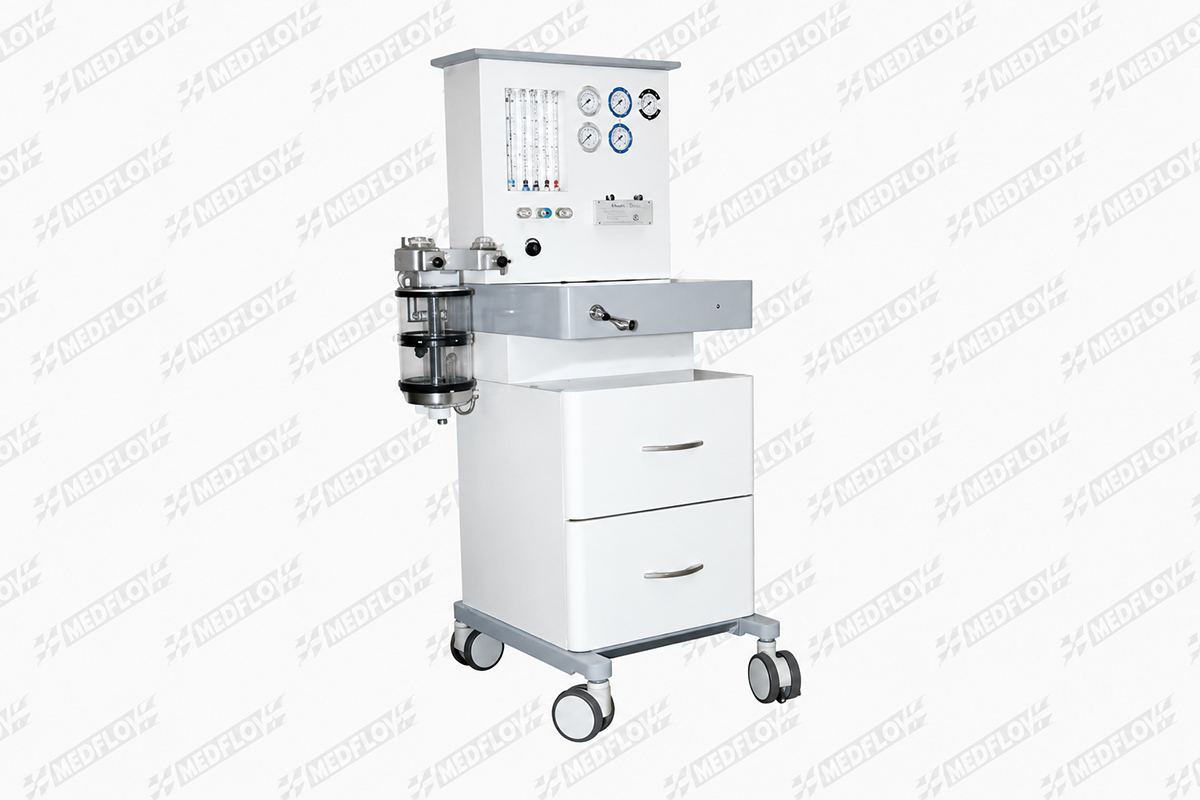
Anesthesia Machine
Anesthesia Machine Manufacturer in India — Complete Guide for Hospitals
Randall Medical Technologies Private Limited (Randall Care) manufactures 3-gas Anesthesia Machines in India, engineered for precise, continuous delivery of oxygen, nitrous oxide, and medical air across general surgery, orthopedic, ENT, gynaecology, and multi-specialty operating theatres. With over 25 years of experience and more than 500 hospitals served, Randall Care's anesthesia workstations combine a 5-tube rotameter, a built-in hypoxic guard, an oxygen failure audio-visual alarm, and an integrated mechanical ventilator — giving anaesthesiologists safe, dependable control through induction, maintenance, and emergence.
What Is an Anesthesia Machine?
An anesthesia machine is the OT workstation that draws medical gases — oxygen, nitrous oxide, and medical air — from the hospital's gas supply or MGPS line, regulates their flow and pressure to a safe level, vaporises volatile anaesthetic agents into the final gas mixture, and delivers that mixture to the patient's airway through a breathing circuit. A mechanical ventilator is connected to the same circuit and can be switched off for spontaneous or manual (bag) ventilation whenever the anaesthesiologist needs direct control.
Because the machine sits between the hospital's gas source and the patient's airway for the entire duration of a surgical procedure, every component — from the rotameter to the CO2 absorber — has to perform without interruption. A single fault in gas mixing, pressure regulation, or ventilation can affect a patient mid-procedure, which is why anesthesia machines are treated as high-risk, tightly regulated medical devices rather than general hospital equipment.
Why Hospitals Need a Reliable Anesthesia Machine
- Patient safety — precise, contamination-free gas mixing and delivery throughout surgery, with built-in protection against hypoxic gas mixtures
- Anaesthesiologist control — seamless switching between mechanical ventilation and manual/spontaneous breathing without disconnecting the patient
- Regulatory compliance — CDSCO registration and NABH accreditation both require anesthesia machines that meet defined safety and performance standards
- OT efficiency — a dependable workstation reduces case delays and turnover time between surgeries
- Emergency readiness — audio-visual alarms flag oxygen failure or pressure deviation before it becomes a patient-safety event
Key Components of an Anesthesia Machine
A complete anesthesia workstation is built from several interdependent systems, each of which has to be matched to the others for safe, accurate gas delivery:
- Gas supply connections — pipeline inlets (from MGPS) and cylinder yokes for oxygen, nitrous oxide, and medical air, with non-interchangeable, gas-specific fittings
- 5-tube rotameter (flowmeter bank) — sets and displays the flow rate of each gas being mixed into the fresh gas flow
- Hypoxic guard — a mechanical or pneumatic safety interlock that prevents the oxygen percentage in the gas mixture from falling below a safe threshold, even if nitrous oxide flow is increased
- Vaporiser — meters a precise concentration of volatile anaesthetic agent into the fresh gas flow
- Breathing circuit and CO2 absorber — carries the gas mixture to the patient and scrubs exhaled carbon dioxide so gas can be safely rebreathed
- Integrated mechanical ventilator — delivers controlled mandatory or assisted breaths, with adjustable tidal volume, rate, and pressure limits
- Oxygen failure audio-visual alarm — alerts OT staff immediately if oxygen supply pressure drops
- AGSS connection — routes waste anaesthetic gas to the hospital's scavenging system rather than into the OT air
Randall Care engineers each of these as part of a single workstation rather than a bundle of separately sourced parts — so the rotameter, hypoxic guard, vaporiser, and ventilator are all sized and calibrated to work together, rather than being matched on-site by the buyer.
Anesthesia Machine Standards and Compliance in India
Anesthesia machines are classified as high-risk medical devices under India's Medical Devices Rules, 2017, and require CDSCO registration before they can be manufactured, sold, or distributed. Choosing a manufacturer that designs to the correct standards directly affects CDSCO approval status, NABH accreditation, and — most importantly — patient safety. Randall Care's anesthesia machines are designed and manufactured with reference to:
- Medical Devices Rules, 2017 (CDSCO) — anesthesia machines fall under Class C/D, requiring CDSCO manufacturing licence and device registration through the Sugam portal
- ISO 8835 — the international standard series governing anaesthetic workstations and their components (gas mixing, vaporisers, breathing systems, ventilators, alarms)
- ISO 13485 — quality management system standard for consistent design, manufacture, and testing of medical devices
- IS 13450 — Indian Standard for medical device labelling, covering the information required on the machine and its packaging
Every unit is factory-tested for gas mixing accuracy, alarm function, and ventilator performance before dispatch, so hospitals have documentation ready for CDSCO records and NABH infrastructure audits.
Anesthesia Machine Specifications — What Hospitals Should Check
Randall Care's 3-gas anesthesia workstation is built around the following core specifications:
|
Specification |
Detail |
|
Gas configuration |
3-gas system — oxygen, nitrous oxide, medical air |
|
Flow control |
5-tube rotameter with individual gas flow calibration |
|
Safety interlock |
Built-in hypoxic guard prevents sub-safe oxygen concentration |
|
Alarms |
Oxygen failure audio-visual alarm; low-pressure alerts |
|
Ventilation |
Integrated mechanical ventilator with manual/spontaneous bypass |
|
Circuit |
CO2 absorber with breathing circuit for closed/semi-closed operation |
|
Applications |
General surgery, orthopedic, ENT, gynaecology, multi-specialty OTs |
|
Compliance |
Manufactured with reference to ISO 8835, ISO 13485, IS 13450; CDSCO-registrable |
Hospital biomedical teams evaluating quotations should ask any anesthesia machine manufacturer to confirm each of these specifications in writing, along with CDSCO registration status for the specific model being quoted — not just the company's general registration.
What Determines Anesthesia Machine Price in India?
Anesthesia machine pricing varies by configuration rather than a single flat rate, because OT requirements differ by procedure mix and hospital scale. The main cost drivers are:
- Number of gas channels — a basic 2-gas (oxygen, nitrous oxide) unit versus a full 3-gas system with medical air
- Ventilator sophistication — basic volume-controlled ventilation versus multi-mode ventilators with pressure-controlled and SIMV options
- Vaporiser count and type — single-agent versus dual-agent vaporiser mounting
- Monitoring integration — built-in gas and patient monitoring versus a standalone monitor mounted separately
- After-sales package — installation, staff training, spare parts availability, and AMC coverage bundled into the quote
A general-surgery OT running standard procedures typically needs a simpler configuration than a multi-specialty hospital running ENT, gynaecology, orthopedic, and laparoscopic cases on the same machine across shifts. Randall Care provides a configuration-specific quote after understanding the case mix and OT volume, rather than publishing a single fixed price that would misrepresent either end of that range.
Anesthesia Machine Applications Across Hospital Departments
Randall Care's anesthesia workstations are deployed across a range of surgical and critical-care settings, each with slightly different demands on the machine:
- General surgery OTs — longer procedures requiring stable, sustained gas delivery and ventilator performance over several hours
- Orthopedic OTs — often combined with regional or spinal techniques, so the machine needs to support both general anaesthesia and standby/monitored sedation modes
- ENT OTs — shared-airway procedures where precise gas control and rapid mode-switching matter for airway safety
- Gynaecology and obstetric OTs — quick-turnover procedures with an emphasis on reliable, repeatable start-up between cases
- Multi-specialty OTs — a single machine rotated across departments, which puts a premium on build durability and consistent calibration
Anesthesia Machine Installation, Training, and Commissioning
Randall Care supports hospitals through the full deployment cycle rather than treating delivery as the end of the engagement:
- Requirement assessment — case mix, OT volume, and existing gas supply/MGPS connection points
- Configuration and quotation — gas channels, ventilator mode, vaporiser count, and monitoring integration matched to the OT's needs
- Factory testing — gas mixing accuracy, hypoxic guard function, alarm response, and ventilator calibration verified before dispatch
- On-site installation and connection — integration with the hospital's existing gas pipeline and AGSS lines
- Commissioning checks — full functional test performed in the OT before handover
- Staff training — orientation for anaesthesiologists, OT nurses, and biomedical engineers on operation, alarms, and emergency procedures
Anesthesia Machine AMC and After-Sales Support
An anesthesia machine is only as dependable as its ongoing calibration and maintenance. Randall Care offers AMC packages covering routine inspection, gas-mixing calibration, alarm testing, and ventilator performance checks — helping hospitals keep the machine audit-ready for CDSCO and NABH reviews and minimising the risk of a mid-procedure fault. A well-structured AMC includes scheduled preventive visits, calibration logs for the rotameter and hypoxic guard, replacement of wearing components such as circuit seals and valves before they fail, and a documented emergency response commitment so OT teams are never left managing a faulty machine mid-list.
Why Hospitals Choose Randall Care for Anesthesia Machines
Randall Medical Technologies Private Limited has spent over 25 years manufacturing hospital equipment — including anesthesia machines, medical gas pipeline systems, pendants, and bed head panels — for more than 500 hospitals, medical colleges, and healthcare institutions across India, including trusted names such as Velammal Hospitals, People Tree Hospitals, and Saveetha Medical College and Hospitals. Because Randall Care also manufactures the MGPS infrastructure, gas outlets, and pendants that surround an OT's anesthesia machine, hospitals get gas supply, workstation, and mounting infrastructure from a single accountable manufacturer instead of coordinating compatibility across multiple vendors.
Being based in Coimbatore also means faster response times for hospitals across Tamil Nadu and South India — whether that's an AMC visit, an emergency callout, or staff retraining after a new OT team joins — compared to coordinating with an out-of-state or imported-equipment vendor for routine service.
Beyond the Anesthesia Machine: A Complete OT Infrastructure Partner
Hospitals commissioning or upgrading an operation theatre can source the full surrounding infrastructure from Randall Care alongside the anesthesia machine:
- Medical Gas Pipeline System (MGPS) — the pipeline network that supplies oxygen, nitrous oxide, and medical air to the anesthesia machine
- AGSS Gas Outlets — scavenging terminal units that connect to the anesthesia machine's waste gas line
- Single and Double Arm Pendants — ceiling-mounted OT pendants that carry gas outlets, monitors, and equipment around the OT table
- Medical Gas Alarm Systems — area and master alarm panels monitoring OT gas supply pressure
- ICU Beds and Bed Head Panels — for post-operative and critical care recovery
Sourcing these from one manufacturer simplifies procurement and ensures the anesthesia machine's gas connections, alarm thresholds, and scavenging line are compatible with the rest of the OT from day one.
Common Mistakes Hospitals Make When Buying an Anesthesia Machine
- Choosing purely on price without confirming CDSCO registration for the specific model quoted
- Not matching ventilator mode options to the hospital's actual case mix, leading to a machine that can't support certain procedures
- Skipping a written specification sheet, leaving no reference point if the delivered unit differs from what was discussed
- Treating AMC as optional rather than building it into the original purchase, so there is no accountable partner once the warranty period ends
- Overlooking gas-supply compatibility between the new machine and the hospital's existing MGPS or cylinder setup
Get a Custom Anesthesia Machine Quote
Whether you are equipping a new OT, replacing an ageing anesthesia machine, or standardising equipment across a multi-specialty facility, Randall Care's team can assess your requirement and provide a detailed, CDSCO-compliant configuration and quote. Call +91 99445 33888 or email info@randall.care to schedule a consultation.
Frequently Asked Questions
What gases does Randall Care's anesthesia machine deliver?
Randall Care's anesthesia machine is a 3-gas workstation delivering oxygen, nitrous oxide, and medical air, mixed through a 5-tube rotameter with a built-in hypoxic guard to prevent unsafe oxygen levels.
Is Randall Care's anesthesia machine CDSCO compliant?
Yes. Randall Care's anesthesia machines are manufactured with reference to CDSCO's Medical Devices Rules, 2017, ISO 8835 for anaesthetic workstations, ISO 13485 quality management, and IS 13450 labelling requirements.
Does the anesthesia machine include a ventilator?
Yes. Every unit has an integrated mechanical ventilator connected to the breathing circuit, which can be switched off for spontaneous or manual (bag) ventilation whenever needed.
What safety alarms does the machine have?
The machine includes an oxygen failure audio-visual alarm and a hypoxic guard interlock, alerting OT staff immediately to any drop in oxygen supply or an unsafe gas mixture.
How much does an anesthesia machine cost in India?
Pricing depends on gas channel count, ventilator sophistication, vaporiser configuration, and monitoring integration. Randall Care provides a configuration-specific quote based on the hospital's case mix and OT volume.
Does Randall Care provide AMC for anesthesia machines?
Yes. Randall Care offers annual maintenance contracts covering calibration, alarm testing, ventilator checks, and emergency response support to keep the machine audit-ready and reliable between services.