


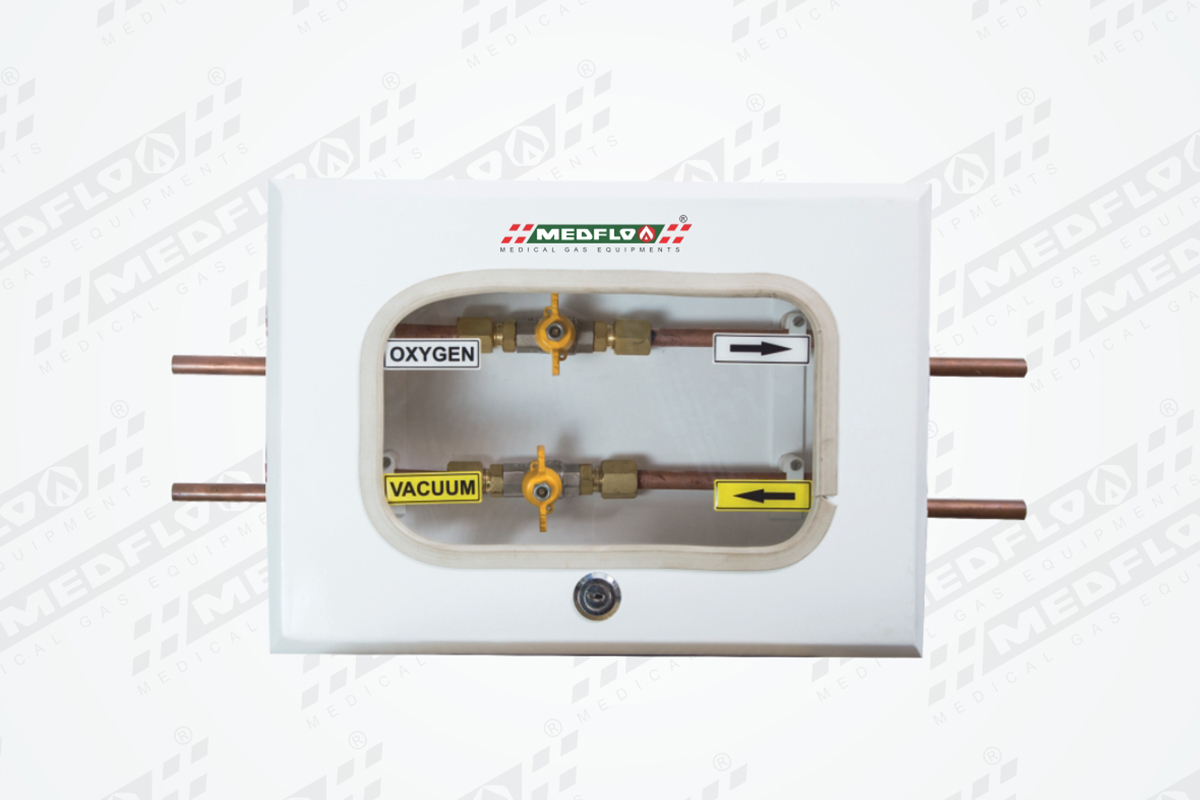
Area Valve Box
Medical Gas Area Valve Box — Zone Isolation for Safer Hospital Gas Pipelines
A Medical Gas Area Valve Box, also called a Zone Valve Box or Area Valve Service Unit (AVSU), is the control point that lets a hospital shut off or isolate the gas supply to one zone, ward, or department without disturbing gas flow anywhere else in the building. It is one of the most safety-critical components of any Medical Gas Pipeline System (MGPS), and it is required in every zone of a compliant hospital installation — from the operating theatre and ICU to general wards and outpatient areas. Randall Medical Technologies manufactures area valve boxes in Coimbatore for hospitals, nursing homes, and MGPS contractors across India, built to isolate oxygen, nitrous oxide, medical air, vacuum, and other piped gases cleanly and reliably.
What Is a Medical Gas Area Valve Box?
An area valve box is a wall-mounted enclosure that houses one or more shut-off valves for a piped medical gas system. Each valve inside the box controls the gas supply to a specific area of the hospital — a single ward, an operating theatre suite, an ICU pod, or a floor. Instead of shutting down the entire hospital's gas supply for a leak, a burst pipe, planned maintenance, equipment testing, or future expansion work, staff or maintenance engineers can close just the valve for the affected zone. Every other department continues to receive an uninterrupted gas supply.
This zone-by-zone control is what separates a properly designed Medical Gas Pipeline System from a basic single point-of-shutoff system, and it is why area valve boxes are treated as mandatory infrastructure — not an optional accessory — in hospital planning and MGPS tender specifications.
How a Medical Gas Area Valve Box Works
Inside the box, valves are arranged horizontally, one per gas service (oxygen, nitrous oxide, medical air, surgical vacuum, AGSS, and other piped gases as required). Each valve line typically includes:
- A shut-off valve — quarter-turn operation for a fast, unambiguous open/closed state in an emergency.
- A color-coded gas identification label so staff can confirm the correct line before closing a valve.
- An analogue pressure gauge for that gas line, used both for routine monitoring and to verify the emergency supply connection to the hospital's Medical Gas Alarm System.
- Top-entry pipe connections, keeping the supply and distribution pipework tidy above the box rather than crossing the front panel.
The enclosure has an easy-open front window so any authorised staff member can reach the valves quickly during an emergency, while the box's mounting height and location are chosen to prevent unauthorised or accidental tampering during normal operation.
Construction, Materials & Design Features
- Housing: Mild steel (MS) construction with a mat/matte powder-coated finish for corrosion resistance and a clean clinical appearance.
- Access window: Hinged or removable front window for rapid access during emergencies, with a design that keeps the window from being closed while a valve is left open — a safety detail specified in international zone valve box standards.
- Valve layout: Valves are arranged horizontally within the box, smallest to largest / logically grouped by gas service, for easy identification under pressure.
- Pipe entry: Top-entry connection layout, which simplifies routing from the ceiling void and keeps the installation neat in false-ceiling corridors.
- Gauges: Dedicated analogue pressure gauge per line for at-a-glance verification of supply pressure and alarm-system connectivity.
- Mounting: Recessed or surface (exposed) wall mounting options to suit corridor, utility room, or nursing-station installation.
This construction mirrors what international zone valve box specifications call for — 16–18 gauge steel bodies, epoxy or powder-coat finishing, ball or full-port shut-off valves, and clearly labelled, gauge-monitored lines — while being built and finished for Indian hospital procurement and NABH-oriented facility requirements.
Standards & Compliance Context
Area/zone valve boxes are typically specified as part of an MGPS design that follows NFPA 99 (Health Care Facilities Code) principles internationally, and in India are commonly aligned with hospital planning guidance drawn from NABH facility requirements and international references such as HTM 02-01. Compliant installations generally expect:
- Clear, permanent gas-service labelling on every valve and on the box itself.
- A window or door that cannot be closed while any housed valve remains shut/emergency-activated, so an open emergency shut-off is always visible.
- Installation in an accessible, clearly signed location known to clinical and facilities staff — typically a corridor, utility room, or near a nursing station.
- Routine testing as part of the hospital's MGPS maintenance schedule, alongside the Medical Gas Alarm System.
Where Area Valve Boxes Are Installed in a Hospital
- Operating theatre (OT) complexes and OT corridors
- Intensive Care Units (ICU, NICU, PICU)
- General wards and semi-private rooms
- Emergency and casualty departments
- Labour rooms and maternity wards
- Diagnostic and procedure rooms
- Riser shafts and floor-wise distribution points in multi-storey hospital buildings
A well-planned MGPS layout places one area valve box per zone or per floor, so any single zone can be isolated for testing, repair, or emergency response without affecting patient care anywhere else.
Key Benefits of Randall's Medical Gas Area Valve Box
- Zone isolation without hospital-wide shutdown — maintenance and repairs happen with zero disruption to unaffected departments.
- Faster emergency response — quarter-turn valves and an easy-access window mean staff can isolate a leak in seconds.
- At-a-glance monitoring — dedicated pressure gauges per gas line support both daily checks and formal MGPS testing.
- Durable, corrosion-resistant build — MS body with a mat finish, designed for long-term use in hospital corridors and utility areas.
- Tamper-resistant placement — accessible to trained staff, positioned to discourage casual interference.
- Configurable — number of valves, gas services, and mounting style built to each hospital's MGPS drawing.
- Backed by an established Indian manufacturer — supplied alongside Randall's full medical gas outlet, alarm system, and pipeline accessory range, simplifying vendor coordination for contractors.
Technical Specifications
|
Parameter |
Details |
|
Product Type |
Medical Gas Area Valve Box / Zone Valve Box (AVSU) |
|
Housing Material |
Mild Steel (MS), mat finish |
|
Valve Arrangement |
Horizontal, one valve per gas service |
|
Access |
Front window, easy-open for emergency access |
|
Pipe Connection |
Top entry |
|
Monitoring |
Analogue pressure gauge per gas line |
|
Gas Services Supported |
Oxygen, Nitrous Oxide, Medical Air, Vacuum, AGSS, and other piped gases as specified |
|
Mounting |
Recessed or surface wall mounting |
|
Typical Installation Points |
OT complexes, ICUs, wards, corridors, riser shafts, nursing stations |
|
Configuration |
Custom valve count and gas-service combination per project MGPS drawing |
Installation & Maintenance Guidance
- Install at an accessible, clearly signed location known to both clinical and facilities staff — typically a corridor or utility room, not inside a locked plant room.
- Label every valve for its exact gas service and the area it controls, per your MGPS drawing.
- Include the area valve box in scheduled MGPS testing alongside your Medical Gas Alarm System, so pressure gauges and shut-off function are verified on a routine cycle.
- Coordinate area valve box locations with your MGPS design consultant during the planning stage — retrofitting locations later is far more disruptive than planning zone boundaries up front.
Why Choose Randall Medical Technologies as Your Area Valve Box Manufacturer
Randall Medical Technologies is a Coimbatore-based manufacturer of hospital medical gas pipeline equipment, supplying medical gas outlets, AGSS outlets, alarm systems, area valve boxes, and full MGPS pipeline accessories to hospitals and contractors across South India and beyond. Because the area valve box is manufactured alongside Randall's own outlets, alarm systems, and pipeline components, hospitals and EPC/MGPS contractors get matched, compatible equipment from a single manufacturer — simplifying procurement, installation coordination, and after-sales support instead of sourcing zone valve boxes from a separate vendor.
If you're finalising an MGPS design, upgrading an existing hospital's gas pipeline, or sourcing equipment for a new build, contact Randall's team with your zone count and gas-service requirement for a configuration and quote.
Choosing the Right Area Valve Box for Your Project
Not every zone needs the same configuration. When you're finalising an MGPS drawing or a hospital renovation tender, a few decisions determine which area valve box configuration is right for that zone:
- Number of gas services in that zone — a standard ward may only need oxygen and vacuum, while an OT suite typically needs oxygen, nitrous oxide, medical air, vacuum, and AGSS in the same box.
- Recessed vs surface mounting — recessed boxes sit flush with the wall for a cleaner corridor finish; surface-mounted boxes are faster to retrofit into an existing building without cutting into the wall.
- Gauge requirement — most hospitals fit a gauge on every line for continuous visual monitoring, though some lower-priority zones may only need gauges on critical gases.
- Access frequency — zones with frequent testing or renovation work benefit from a larger, easier-to-open window and a location near a nursing station rather than a back corridor.
Sharing your MGPS drawing, floor plan, or gas-service list with Randall's team lets us confirm the right valve count and layout before manufacturing, so the box arrives ready to install without on-site rework.
Frequently Asked Questions
What is the difference between an area valve box and a zone valve box?
They're the same device — "area valve box" and "zone valve box" (sometimes shortened to AVB or called an Area Valve Service Unit / AVSU) both refer to the wall-mounted enclosure that houses shut-off valves for isolating one hospital zone's medical gas supply.
How many valves can one area valve box hold?
This depends on how many gas services (oxygen, nitrous oxide, medical air, vacuum, AGSS, etc.) need to be controlled for that zone. Randall configures each box to the project's MGPS drawing rather than a single fixed count.
Where should an area valve box be installed in a hospital?
In an accessible, clearly signed location that clinical and facilities staff know — typically a corridor, utility room, or near a nursing station serving that zone — so it can be reached quickly in an emergency.
Why does a hospital need multiple area valve boxes instead of one main shut-off?
A single main shut-off would cut gas supply to the entire hospital for any repair, test, or emergency. Zone-by-zone area valve boxes let staff isolate only the affected area, so the rest of the hospital continues functioning normally.
Does Randall supply area valve boxes with pressure gauges fitted?
Yes — each gas line inside the box is fitted with a dedicated analogue pressure gauge, used for routine monitoring and to verify the emergency connection to the Medical Gas Alarm System.
Can the area valve box be customised for our hospital's MGPS layout?
Yes. Valve count, gas services, and mounting style (recessed or surface) are configured to match your project's MGPS design.