


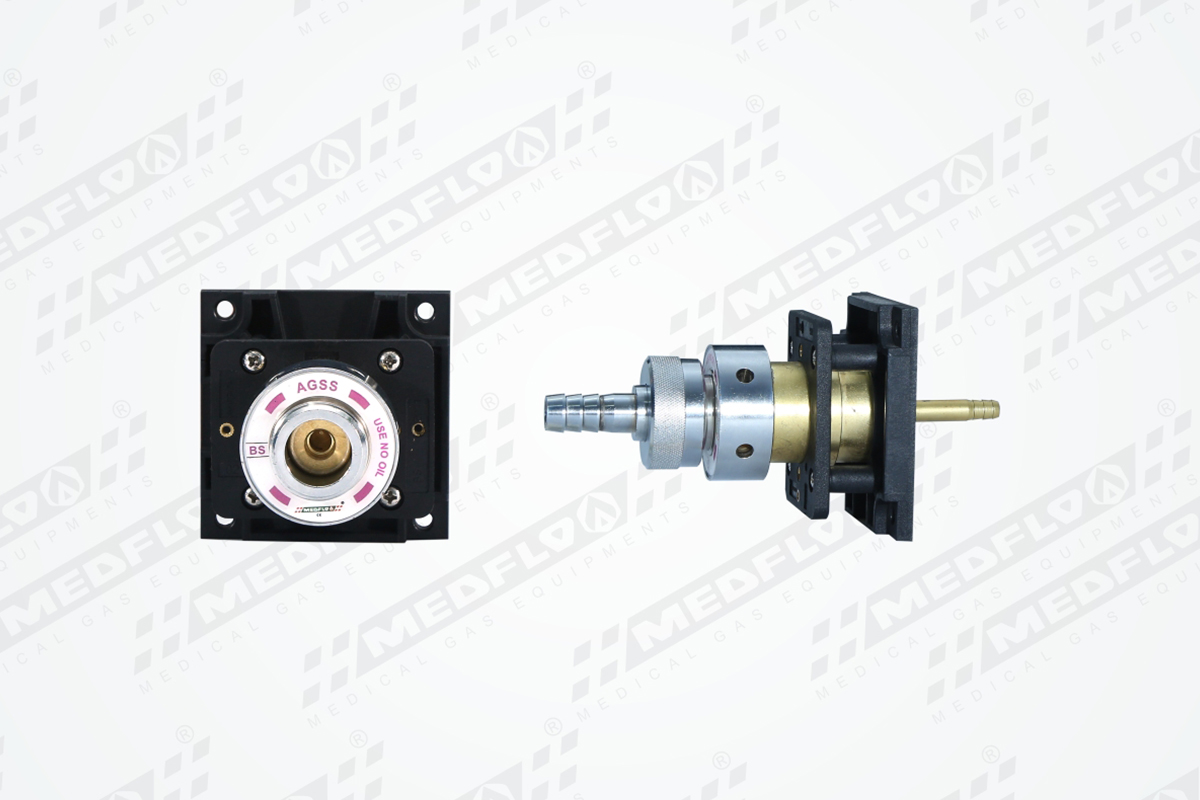
AGSS Gas Outlets
AGSS Gas Outlet — Anaesthetic Gas Scavenging System Outlet Manufacturer
Every operating theatre that uses inhalational anaesthesia needs a way to remove the gas the patient breathes out but never absorbs. That job belongs to the AGSS gas outlet — the Anaesthetic Gas Scavenging System outlet, or AGSS terminal unit, fitted into the hospital's medical gas pipeline wherever an anaesthesia workstation is used. Randall Medical Technologies manufactures AGSS gas outlets from its Coimbatore facility, supplying hospitals, nursing homes, and hospital-construction contractors across India with a component that is easy to overlook on a drawing but essential on the floor of a live OT.
This page covers what an AGSS outlet is, how Randall's AGSS terminal unit is built, where it is installed, and why hospitals and MEP consultants across South India specify Randall as their medical gas outlet manufacturer.
What Is an AGSS Gas Outlet?
An AGSS gas outlet is the wall- or panel-mounted terminal point of a hospital's Anaesthetic Gas Scavenging System — the dedicated pipeline that continuously draws waste anaesthetic gas and vapour away from the anaesthesia machine and the patient breathing circuit, and carries it outside the building. Without an AGSS outlet at every anaesthetising location, residual nitrous oxide and volatile anaesthetic agents build up in the room air and are inhaled by anaesthetists, surgeons, nurses, and other OT staff, shift after shift.
The AGSS outlet is the interface point: the anaesthesia machine's scavenging port is connected to the AGSS terminal unit using a dedicated hose, and the terminal unit itself is plumbed into a separate scavenging pipeline that leads to a disposal or receiving system, often via an active extraction unit. Because the AGSS pipeline is a completely separate circuit from the oxygen, nitrous oxide, medical air, and vacuum lines, the AGSS outlet is deliberately designed as a non-interchangeable, gas-specific terminal unit — it should not physically accept a hose or probe intended for any other medical gas service, and no other gas outlet should accept an AGSS probe. This is the same non-interchangeability principle followed across medical gas pipeline design generally, and it's a key reason hospitals insist on outlets and probes purpose-built for AGSS use, rather than adapted general-purpose fittings.
Why AGSS Outlets Matter in Operating Theatre Design
Anaesthetic gas exposure is a recognised occupational health concern in operating theatres, recovery rooms, and delivery suites. Repeated low-level exposure to waste anaesthetic gas has been linked in occupational health literature to headaches, fatigue, and other symptoms among theatre staff, which is why anaesthetic gas scavenging is treated as a standard part of OT infrastructure rather than an optional extra.
For hospital planners, biomedical engineers, and MEP contractors, the AGSS outlet is therefore a fixed line item in every new operating theatre, cath lab, delivery room, and procedure room where general anaesthesia or sedation with volatile agents is administered. Specifying a well-built AGSS terminal unit — one with a reliable check valve, a properly seated probe, and a leak-tight brass fixture — directly affects how consistently the scavenging system performs over years of daily use.
Components of Randall's AGSS Gas Outlet — Built for a Sealed, Reliable Terminal Unit
Randall's AGSS gas outlet is assembled from precision-machined parts, each doing a specific job in keeping the scavenging connection sealed, gas-specific, and durable under daily hospital use:
- Base Plate — the mounting plate that fixes the AGSS outlet body to the wall, panel, or pendant, keeping the terminal unit rigid and correctly aligned behind the front escutcheon.
- Hose Nipple — the fitting on the rear of the outlet where the AGSS pipeline hose connects, forming the sealed link between the outlet and the building's dedicated scavenging pipeline.
- Brass Fixture — the core body of the AGSS outlet, machined in brass for corrosion resistance and dimensional stability over years of probe insertion and removal.
- Brass Fixture Lock Plate — secures the brass fixture firmly within the outlet housing, preventing movement or loosening from repeated use.
- Spring — provides the controlled return tension that keeps the AGSS probe seated and the internal valve properly biased when the probe is inserted or withdrawn.
- Check Valve — the non-return valve that maintains the direction of gas flow into the scavenging line and helps preserve the seal when no probe is connected.
- Check Valve Housing — the machined housing that holds the check valve in position and protects it from damage during routine use.
- Rubber Washer — provides the airtight seal between mating components, preventing leakage at the outlet-to-probe interface.
- AGSS Probe — the gas-specific probe that connects the anaesthesia machine's scavenging hose to the AGSS outlet; shaped so it cannot be inserted into oxygen, vacuum, or other medical gas outlets.
- AGSS Probe Lock Nut — secures the probe assembly to its hose connection, keeping the scavenging line connection tight and leak-free.
Every one of these components is manufactured and quality-checked at Randall's Coimbatore facility before assembly, so that each AGSS terminal unit leaving the factory seals correctly on first fit and continues to perform through years of insertion cycles.
AGSS Back Entry vs. AGSS Probe (Front-Entry) Outlets
Randall supplies AGSS gas outlets in the two configurations hospitals most commonly specify:
- AGSS Back Entry Outlet — the pipeline connection enters from behind the wall or panel, keeping the front face of the outlet clean and flush for pendant, bed-head panel, or wall installations where the pipeline routes within the wall cavity.
- AGSS Probes (Front-Entry) Outlet — designed for surface-mounted installations or retrofit projects where routing the scavenging pipeline behind the wall isn't practical, with the probe connection accessible from the front.
Choosing between the two usually comes down to how the OT's medical gas pipeline is routed and whether the installation is a new build or a retrofit into an existing structure — our team can advise on which configuration suits a given hospital layout.
Where AGSS Terminal Units Are Installed
An AGSS gas outlet is needed wherever an anaesthesia machine or anaesthesia workstation is in regular use. Typical installation points include:
- Main operating theatres (OTs) and OT complexes
- Cardiac cath labs and hybrid operating rooms
- Labour and delivery rooms
- Day-care surgery and minor procedure rooms
- ICUs and recovery/post-anaesthesia care units where inhalational sedation is used
- Dental surgical suites administering general anaesthesia
As a medical gas outlet manufacturer, Randall supplies AGSS terminal units for both new hospital construction and the retrofit or expansion of existing operating theatre blocks, working alongside hospital planners, biomedical consultants, and medical gas pipeline (MGPS) contractors.
Build Quality and Design Approach
Anaesthetic gas scavenging disposal systems and their terminal units are widely referenced against international frameworks such as ISO 7396-2 (which covers anaesthetic gas scavenging disposal systems), ISO 9170-2 (which covers terminal unit specifications), and hospital technical guidance documents such as HTM 02-01 used for medical gas pipeline design. Randall's AGSS outlets are engineered with these same design principles in mind — gas-specific, non-interchangeable connections, leak-tight sealing, and a reliable check valve — so hospitals can specify AGSS terminal units that fit into a pipeline designed around these frameworks. We're happy to share detailed technical drawings and material specifications for your consulting engineer or biomedical team to review against your project's specific compliance requirements.
Why Hospitals Choose Randall Medical Technologies
Randall Medical Technologies is a Coimbatore-based manufacturer of hospital gas outlets and operating theatre equipment, with a track record among hospital administrators and medical gas pipeline contractors across South India. Choosing Randall for your AGSS gas outlet requirement means:
- A single manufacturer for AGSS outlets, medical gas outlets, British Standard medical gas outlets, JPN outlets, area valve boxes, alarm systems, and pipeline accessories — simplifying vendor management on large hospital projects.
- In-house machining of brass fixtures and probes, giving tighter control over fit, finish, and leak-tightness than outlets assembled from bought-out parts.
- Manufacturing and supply experience across healthcare, hospital-construction, and MEP contracting projects, with the ability to support both single-outlet orders and full-hospital bulk supply.
- A Coimbatore manufacturing base that keeps lead times and logistics practical for hospital projects across Tamil Nadu, South India, and pan-India dispatch.
Installation and Maintenance
Randall's AGSS gas outlets are designed for straightforward installation by medical gas pipeline contractors during OT fit-out, and for easy servicing afterward — the probe, spring, check valve, and washer are all replaceable parts, so a terminal unit can be refurbished on-site rather than removed and re-plumbed. We recommend periodic testing of AGSS terminal units as part of routine medical gas pipeline maintenance, in line with the hospital's overall AGSS and MGPS testing schedule.
Frequently Asked Questions — AGSS Gas Outlet
What does AGSS stand for?
AGSS stands for Anaesthetic Gas Scavenging System — the dedicated pipeline and outlet network that removes waste anaesthetic gas from operating theatres and other anaesthetising locations.
What is the difference between an AGSS outlet and a regular medical gas outlet?
A regular medical gas outlet (oxygen, nitrous oxide, medical air, vacuum) supplies or draws a specific medical gas to or from the patient circuit. An AGSS outlet is a scavenging outlet — it carries waste anaesthetic gas away from the anaesthesia machine to a separate disposal pipeline, and is built with a gas-specific probe so it cannot be confused with any other outlet.
Where should an AGSS terminal unit be installed?
An AGSS terminal unit should be installed at every location where an anaesthesia machine or workstation is used, including main operating theatres, cath labs, delivery rooms, and day-care surgery rooms.
What's the difference between AGSS Back Entry and AGSS Probe outlets?
Back Entry outlets are connected to the scavenging pipeline from behind the wall or panel, suiting new-build installations. Probe (front-entry) outlets are connected from the front face, suiting surface-mounted or retrofit installations.
Does Randall supply AGSS outlets for hospital projects outside Coimbatore?
Yes. While Randall is based in Coimbatore, we supply AGSS gas outlets and full medical gas pipeline accessories to hospitals and contractors across Tamil Nadu, South India, and pan-India.
Can worn AGSS outlet parts be replaced without removing the whole unit?
Yes. The probe, spring, check valve, rubber washer, and lock nut are individually replaceable, allowing an AGSS terminal unit to be serviced in place rather than fully removed and re-piped.
What to Check When Specifying an AGSS Gas Outlet
Because the AGSS outlet sits behind the scenes of most OT walkthroughs, it's easy for a specification to gloss over details that matter once the theatre is in daily use. When comparing AGSS terminal unit suppliers, it's worth checking:
- Whether the brass fixture and probe are machined in-house or bought out — in-house machining generally gives tighter tolerances and a more consistent seal across a bulk order.
- Whether the check valve and spring are individually serviceable, so a worn outlet can be refurbished without replumbing the wall.
- Whether the manufacturer offers both AGSS Back Entry and AGSS Probe (front-entry) configurations, so the same vendor can supply new-build and retrofit projects.
- Whether the same manufacturer also supplies the rest of the medical gas outlet range — oxygen, vacuum, nitrous oxide, and medical air outlets — so probe and outlet colour-coding and gas-specific non-interchangeability are consistent across the whole OT.
- Turnaround time and after-sales support for spare parts, particularly probes and washers, which see the most wear.
Randall's AGSS gas outlet range is built to answer each of these points directly, which is why hospital-planning consultants and MEP contractors across South India specify us alongside our wider medical gas outlet and hospital pipeline accessory range.
Materials, Finish, and Corrosion Resistance
The AGSS outlet's brass fixture and probe are the two components that see the most repeated contact — every anaesthesia case involves inserting and withdrawing the probe at least once. Brass is used for the fixture body specifically because it resists the corrosion that stainless or mild-steel alternatives can develop under repeated handling and routine surface disinfection, while still holding the fine tolerances needed for the probe-to-outlet seal. The rubber washer is selected for long-term elasticity, so the seal doesn't harden or crack after repeated insertion cycles over years of theatre use, and the check valve housing is machined to protect the valve mechanism from the knocks and general wear of a busy OT.
Randall finishes every AGSS outlet component to the same quality standard used across our medical gas outlet range, so hospitals get consistent build quality whether they're ordering a single AGSS terminal unit for a retrofit or a full set for a new OT block.
AGSS Outlets as Part of a Complete Hospital Gas Pipeline
An AGSS gas outlet is rarely ordered in isolation — it's specified alongside the rest of a hospital's medical gas pipeline system (MGPS): oxygen and nitrous oxide outlets, medical air and vacuum outlets, area valve boxes, NIST connectors, low-pressure alarm systems, and concealed boxes for the pipeline routing itself. Randall manufactures this entire range from the same Coimbatore facility, which lets hospital-construction contractors and biomedical planners source their full OT gas outlet and medical gas pipeline outlet requirement — AGSS included — from one manufacturer, with consistent quality, matched finishes, and a single point of contact for technical queries, spares, and after-sales support.
Get an AGSS Gas Outlet Quote
Talk to our team for AGSS gas outlet specifications, drawings, and pricing for your hospital, nursing home, or OT construction project. Randall Medical Technologies supplies AGSS terminal units, medical gas outlets, and complete hospital pipeline accessories from a single Coimbatore manufacturing facility — call +91 99445 33888 or email info@randall.care.