


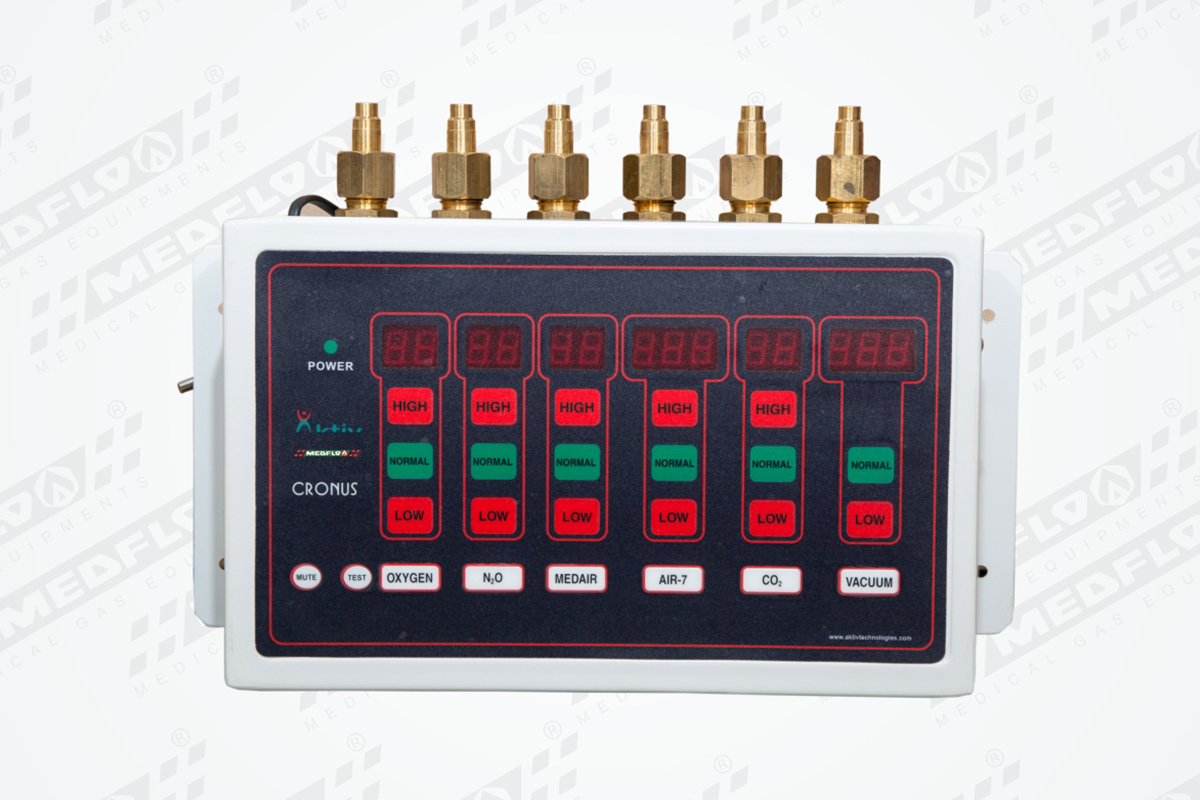
Medical Gas Alarm System
Medical Gas Alarm System for Hospital Pipeline Monitoring
Every hospital depends on an uninterrupted supply of medical gases to keep patients safe, and the medical gas alarm system is the component that stands guard over that supply every second of every day. Randall Medical Technologies designs, manufactures, and supplies medical gas alarm systems that continuously track the pressure and status of the central medical gas pipeline system (MGPS), covering oxygen, nitrous oxide, medical air, carbon dioxide, nitrogen, and vacuum lines. The moment any parameter drifts outside its safe operating range, the alarm raises a dual visual and audible warning so that clinical and technical staff can respond before the deviation becomes a patient-safety incident.
Unlike a simple pressure gauge that only shows a number, a medical gas alarm system is an active monitoring and warning device. It watches the pipeline network around the clock, compares live readings against preset high and low thresholds, and immediately notifies the people who need to know, wherever they happen to be in the building. In critical areas such as intensive care units, operation theatres, neonatal wards, and emergency departments, this early warning can be the difference between a routine maintenance call and a genuine clinical emergency.
Why Every Hospital Needs a Reliable Gas Alarm System
Medical gases are classified as drugs under most national pharmacopoeia standards, and hospitals are legally and clinically obligated to guarantee their purity, pressure, and continuous availability. A single undetected drop in oxygen pressure during a surgical procedure, or an unnoticed vacuum failure in an ICU, can put lives at risk within minutes. This is precisely why regulatory frameworks and hospital accreditation bodies require every medical gas pipeline system to be fitted with area alarms and a master alarm as a mandatory safety layer, not an optional extra.
A well-designed medical gas alarm system does more than protect patients during an active failure. It also gives biomedical engineering teams the visibility they need to plan preventive maintenance, track gas consumption trends, and demonstrate compliance during hospital audits and NABH or JCI accreditation reviews. Facilities that install a dependable alarm network typically see fewer emergency callouts, faster fault diagnosis, and a measurable reduction in unplanned gas supply interruptions across departments.
Beyond compliance, there is also an operational cost argument. Detecting a slow oxygen leak early, for example, prevents wastage of a costly consumable and avoids the far larger expense of an emergency cylinder changeover in the middle of a procedure. In this sense, the alarm system pays for itself many times over across its operating life, simply by catching small problems before they escalate into large ones.
Understanding MGPS and Where the Alarm Fits In
A Medical Gas Pipeline System, commonly abbreviated as MGPS, is the centralized infrastructure that generates or stores medical gases at a single source — such as a manifold bank, liquid oxygen tank, or medical air compressor — and distributes them through a network of medical-grade copper pipes to every point of use in the hospital. Zone valve boxes allow individual wings or floors to be isolated for maintenance without disrupting gas supply elsewhere, and terminal outlets at the bedside or in the operating theatre let clinicians connect their equipment directly to the pipeline.
The alarm system is the nervous system of this entire network. It sits at every critical junction — the source equipment room, each zone valve box, and the nurse stations or duty rooms that need situational awareness — and continuously reports back on pressure, vacuum level, and changeover status. Randall's medical gas alarm panels are engineered to slot directly into this architecture, whether the installation is a new hospital build or a retrofit into an existing pipeline network.
Because MGPS gases are effectively invisible and odourless when functioning correctly, staff have no natural way of noticing a developing problem without instrumentation. This makes the alarm system, rather than any single physical valve or pipe, the true safety-critical component of the whole installation.
Area Alarms and Master Alarms: What Is the Difference
Randall's medical gas alarm system is built around two complementary alarm layers, and understanding the difference between them is central to specifying the right solution for a hospital project.
An area alarm is a local monitoring panel installed close to the point of clinical use — inside an ICU, an operating theatre, a ward corridor, or a nurse station. Its purpose is to give the clinical team an immediate, local indication if the gas supply serving that specific zone deviates from the set parameters. Because area alarms are placed exactly where patient care is happening, they allow doctors and nurses to react within seconds, well before a problem could affect an ongoing procedure.
A master alarm, in contrast, is typically installed in the plant room, the engineering control room, or wherever the technical and maintenance team is stationed. It aggregates the status of the entire pipeline network — or a defined section of it — and gives biomedical and facilities engineers a single point of reference for the overall health of the system. When any area alarm anywhere in the hospital detects a deviation, the master alarm also activates, ensuring that the technical response team is alerted in parallel with the clinical staff.
This two-tier design, area alarms for local clinical awareness and a master alarm for centralized technical oversight, is what most international MGPS guidelines require, and it is the configuration Randall recommends for any multi-department hospital installation.
Digital vs Analog Medical Gas Alarm Panels
Randall Medical Technologies offers both digital and analog medical gas alarm panels, and hospitals can choose the format that best fits their existing infrastructure, budget, and monitoring preferences.
The analog medical gas alarm warning system uses dial-style pressure indicators combined with LED or lamp-based visual alerts and an audible buzzer. This format is well understood by maintenance teams, is straightforward to service, and remains a dependable, cost-effective choice for hospitals that want proven, no-frills monitoring across single or multiple gas lines.
The digital or screen-touch alarm system takes monitoring a step further with an intuitive touchscreen interface, numeric pressure readouts, and colour-coded status indicators that make it easy to identify which gas line and which zone is affected at a glance. Digital panels from Randall can monitor up to six gases from a single unit, support a mute function for the audible alarm during investigation, and are available with RS-485/Modbus connectivity for integration with a hospital's building management system (BMS). This makes the digital format particularly suited to larger, multi-specialty hospitals that want centralized dashboards and remote monitoring capability.
Both formats share the same underlying safety principle: continuous comparison of live pressure readings against pre-configured high and low set points, with instant visual and audible notification the moment a reading crosses that threshold.
Key Features of Randall's Medical Gas Alarm System
Randall's medical gas alarm systems are built to be dependable in exactly the moments when dependability matters most, and the feature set reflects that priority.
Every panel provides simultaneous visual and audible alerts, so that a deviation is impossible to miss whether staff are looking at the panel or simply working nearby. The audible alarm includes a mute function so that once a fault has been acknowledged, ongoing clinical work is not disrupted by continuous noise, while the visual indicator remains active until the fault is fully resolved.
Gas specification is fully configurable, ranging from a single-gas panel for a small procedure room to a six-gas panel for a full ICU or operating theatre complex, covering oxygen, nitrous oxide, medical air, vacuum, carbon dioxide, and nitrogen as required by the project. Each channel is independently monitored, so a fault on one gas line never masks or interferes with the status of another.
Physical installation uses a standard 3/8 inch BSP nut-and-nipple wall-mounted connection, which is compatible with the medical-grade copper pipework used across virtually all Indian hospital MGPS installations, simplifying both new installation and retrofit projects. Panels are designed for placement in any area or zone, including operating rooms, ward areas, ICUs, and CCUs, with health care workers able to read and respond to the display without specialist technical training.
Randall's engineering team also builds in fail-safe behaviour, meaning that a loss of electrical power to the alarm panel itself is treated as a fault condition and flagged accordingly, rather than silently leaving the hospital without monitoring coverage.
Technical Overview and Specifications
Randall's medical gas alarm panels are available in both analog and digital touchscreen configurations, with gas monitoring capacity ranging from a single line up to six simultaneous gas or vacuum lines per panel. Standard operating voltages of 230V AC, 50Hz or 24V DC are supported to match hospital electrical infrastructure, and panels are wall mounted using a 3/8 inch BSP nut-and-nipple pressure sensing connection for straightforward integration with existing copper pipeline networks.
Digital panels feature colour-coded LED or touchscreen status indicators, numeric pressure display in the unit of measurement specified by the project, an audible alarm with a mute override, and optional RS-485/Modbus output for integration with a hospital building management system or centralized nurse-call network. Area alarm units are designed for surface or flush wall mounting in corridors, nurse stations, ICUs, and operating theatres, while master alarm panels are designed for plant room or engineering control room installation with the capacity to aggregate multiple area alarm zones onto a single display.
Enclosures are built for continuous 24x7 operation in a healthcare environment, and every unit undergoes pressure-response testing before dispatch to confirm that high and low set points trigger the alarm within the expected response time.
Compliance with NFPA 99, ISO 7396-1, and HTM 02-01
Medical gas alarm systems do not operate in a regulatory vacuum. International and national standards define exactly how these alarms must be installed, how they must behave, and what pressure deviation should trigger a response, and Randall's systems are engineered with these frameworks in mind.
ISO 7396-1 is the international standard covering medical gas pipeline systems, including the requirements for both area and master alarm systems, alarm response times, and the labelling and colour-coding of gas lines. NFPA 99, widely referenced across healthcare facility design, sets out health care facilities code requirements including category classifications for medical gas and vacuum systems and the alarm coverage each category demands. HTM 02-01, the UK Health Technical Memorandum for medical gas pipeline systems, is also frequently used as a design reference across hospital projects in India for its detailed guidance on alarm placement and zone valve architecture.
Designing to these standards is not simply a matter of ticking a compliance box. It ensures that alarm thresholds, placement, and response behaviour have been validated against decades of clinical safety experience across thousands of hospital installations worldwide, which is exactly the assurance a hospital administrator or biomedical engineer needs when signing off on a new MGPS installation or an alarm system retrofit.
Where Medical Gas Alarm Systems Are Installed
Randall's area and master alarm panels are suited to virtually every department that depends on a continuous medical gas supply. Intensive care units and critical care units require constant oxygen and vacuum monitoring given the fragility of the patients being treated, making area alarms in the ICU one of the most safety-critical installations in any hospital.
Operation theatres and operating room complexes depend on uninterrupted oxygen, nitrous oxide, and medical air supply throughout a surgical procedure, and an area alarm mounted within clear sightline of the anaesthesia team allows an immediate response to any pressure change without disrupting the sterile field. Neonatal and paediatric intensive care units carry similarly high stakes, given how sensitive newborn patients are to gas supply fluctuations.
General wards, high-dependency units, emergency departments, and diagnostic and treatment areas such as cath labs and endoscopy suites also benefit from area alarm coverage, ensuring that gas monitoring extends beyond the highest-acuity zones to every point where medical gas is delivered to a patient. Central plant rooms, manifold rooms, and engineering control rooms house the master alarm, giving the biomedical and facilities management team a single point of oversight across the entire hospital's gas infrastructure.
Outside of hospitals, the same alarm technology is also used in diagnostic laboratories, pharmaceutical manufacturing facilities, and research institutions wherever a controlled and monitored gas supply is part of the operating requirement.
Installation, Testing, and Maintenance
A medical gas alarm system is only as reliable as its installation and its ongoing maintenance regime. Randall's technical team works with hospital project consultants, MEP contractors, and biomedical engineering departments from the design stage onward, mapping alarm zones against the hospital's floor plan and clinical department layout before finalizing panel placement.
Once installed, every alarm panel is commissioned with a documented pressure-response test, confirming that each gas channel triggers its visual and audible alert at the correct high and low set points. This commissioning record forms part of the hospital's compliance documentation and is typically required during NABH, JCI, or state health department inspections.
Ongoing maintenance is straightforward by design. Panels are built for easy access during routine biomedical equipment checks, and Randall provides after-sales technical support for calibration, sensor replacement, and firmware updates on digital panels. Hospitals are advised to schedule periodic testing of both area and master alarms as part of their standard preventive maintenance calendar, in line with the testing frequency recommended under ISO 7396-1 and NFPA 99.
Why Choose Randall Medical Technologies
Randall Medical Technologies, part of Steel Krishna Industries, brings together manufacturing expertise and healthcare infrastructure experience to deliver medical gas alarm systems that hospitals can depend on. Our panels are manufactured in India, engineered to align with international MGPS standards, and supported by an in-house technical team that understands both the electrical engineering and the clinical context behind every installation.
We work directly with hospital administrators, biomedical engineers, and MEP contractors across new-build and retrofit projects, offering both analog and digital alarm formats, single-gas through six-gas configurations, and the flexibility to design a zone-by-zone alarm layout that matches each hospital's specific department structure. Every system leaves our facility only after pressure-response testing, and our after-sales support extends to on-site commissioning, staff orientation, and long-term maintenance assistance.
For hospitals and healthcare facilities across Coimbatore, Tamil Nadu, and pan-India, Randall Medical Technologies offers a single point of contact for medical gas alarm panels, pendant systems, ICU beds, and the full range of medical gas outlet and pipeline accessories needed to build a complete, compliant MGPS installation.
Benefits of a Well-Monitored Medical Gas Pipeline
The clearest benefit of a properly monitored medical gas pipeline is patient safety, but the advantages extend well beyond the immediate clinical scenario. Continuous monitoring converts an invisible utility into a visible, measurable service, which changes how a hospital's engineering and clinical teams relate to their own infrastructure.
For clinical staff, an area alarm within sight of the bed or the operating table removes the uncertainty around gas supply entirely. Nurses and anaesthetists can focus on the patient rather than periodically checking cylinder gauges or wondering whether a pipeline pressure drop has gone unnoticed. For biomedical engineering teams, the master alarm turns reactive troubleshooting into proactive management, since a developing fault anywhere in the network is flagged at a single console long before it becomes a department-wide outage.
For hospital administrators, a documented, standards-aligned alarm system simplifies accreditation audits, reduces insurance and liability exposure, and provides a clear paper trail of commissioning and maintenance records whenever regulators or accreditation bodies request evidence of MGPS safety compliance. Taken together, these benefits make the medical gas alarm system one of the highest-value, lowest-cost safety investments a hospital can make relative to the risk it mitigates.
Frequently Asked Questions
What is a medical gas alarm system used for?
A medical gas alarm system continuously monitors the pressure and status of medical gas and vacuum lines within a hospital's pipeline network, providing an immediate visual and audible warning if any line deviates from its set operating parameters, so that staff can respond before patient care is affected.
What is the difference between an area alarm and a master alarm?
An area alarm is installed close to the point of clinical use, such as an ICU or operating theatre, to give local staff immediate warning of a fault in that zone. A master alarm is installed in the plant room or engineering control room and aggregates the status of the entire pipeline network, giving the technical team centralized oversight.
How many gases can one alarm panel monitor?
Randall's medical gas alarm panels are configurable from a single gas line up to six gas or vacuum lines on one panel, depending on the department's requirements and the complexity of the installation.
Are these alarm systems compliant with international standards?
Yes. Randall's medical gas alarm systems are designed with reference to ISO 7396-1, NFPA 99, and HTM 02-01, the standards most commonly used to guide medical gas pipeline system design, alarm placement, and response requirements in hospital projects.
Can the alarm system integrate with a hospital's building management system?
Digital touchscreen alarm panels support RS-485/Modbus connectivity, allowing integration with a hospital's building management system or centralized monitoring dashboard for facilities that want remote visibility across multiple departments.
How often should a medical gas alarm system be tested?
Hospitals should schedule periodic functional testing of both area and master alarms as part of their preventive maintenance program, in line with the testing intervals recommended under ISO 7396-1 and NFPA 99, in addition to the initial commissioning test performed at installation.
Get a Medical Gas Alarm System Quote
Whether you are specifying a medical gas alarm system for a new hospital build, upgrading an existing analog panel to a digital touchscreen format, or expanding alarm coverage into additional wards and departments, Randall Medical Technologies can design a solution around your MGPS layout. Reach out to our technical team for panel specifications, gas configuration options, and a project-specific quotation for your hospital or healthcare facility. Our engineers are also available to walk through zone-by-zone alarm placement for multi-block hospital campuses, ensuring that every ICU, operating theatre, ward, and diagnostic unit is brought under a single, coordinated medical gas monitoring plan before installation begins.