


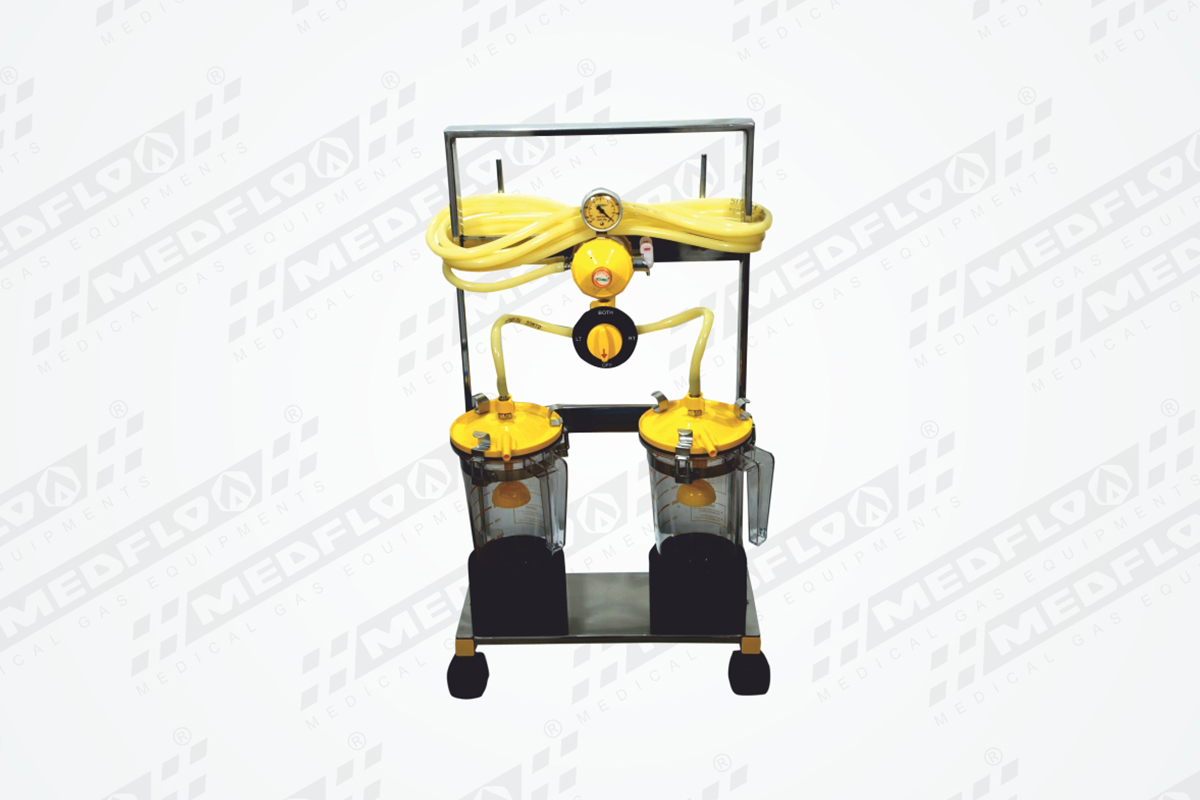
SS Theater Suction Trolley
SS Theater Suction Trolley: The Complete Guide to Operation Theatre Suction Systems
Every operating room depends on one piece of equipment working flawlessly, every single time: the suction system. A surgeon cannot operate on a field obscured by blood, fluid, or secretions, and an anaesthetist cannot manage an airway safely without instant, dependable suction. Randall Medical Technologies manufactures the SS Theater Suction Trolley to meet exactly this need — a stainless steel, dual-jar, mobile suction unit engineered for the demanding pace of operation theatres, intensive care units, labour rooms, and emergency departments. This page walks through what a theater suction trolley is, how Randall's SS Theater Suction Trolley is built, where it is used, and what to check before you buy one for your hospital, nursing home, clinic, or ambulance service.
What Is a Theater Suction Trolley?
A theater suction trolley, also referred to as an operation theatre (OT) suction trolley, surgical suction unit, or vacuum suction trolley, is a mobile medical device that generates and regulates negative pressure (vacuum) to remove blood, body fluids, secretions, and irrigation fluid from a surgical or clinical field. Unlike a fixed wall-suction outlet, a suction trolley is completely portable, which means it can be wheeled between operating rooms, ICU bays, labour rooms, or even loaded into an ambulance when central suction is unavailable or insufficient.
At its core, a suction trolley combines three elements: a vacuum-generating mechanism (a regulator connected to a pump or a central vacuum line), one or more collection jars that trap the aspirated fluid before it reaches the pump, and a mobile chassis with castor wheels that lets theatre staff position the unit exactly where it is needed. The SS Theater Suction Trolley from Randall brings all three elements together in a stainless steel frame designed specifically for the hygiene and durability standards that Indian and international hospitals expect.
Randall SS Theater Suction Trolley — Product Overview
The SS Theater Suction Trolley is built around two unbreakable polycarbonate collection jars, each with a 2000 ml capacity, giving the unit a combined 4000 ml holding volume before a jar needs to be emptied. This dual-jar configuration is deliberate: surgical procedures rarely pause, and a single-jar suction unit forces staff to interrupt suction mid-procedure to empty or replace a full jar. With two jars and a three-way valve system, Randall's suction trolley lets the operating team switch from one jar to the other, or run both simultaneously, without ever losing suction at a critical moment.
Every jar is fitted with an ABS plastic lid that includes a built-in overflow safety valve. This is a critical safety feature: if a jar fills beyond its safe limit, the overflow valve prevents fluid from being drawn into the vacuum regulator or the pump itself, protecting the mechanism from contamination and costly damage. The trolley's negative pressure regulator allows the operating team to dial in the exact vacuum level a procedure requires, and an on/off switch built into the regulator lets staff start or stop vacuum generation instantly, without reaching for a separate control panel.
Key Features of the SS Theater Suction Trolley
The SS Theater Suction Trolley is manufactured with the following features, each chosen to support real operating-room workflow rather than just meet a specification sheet:
- Two unbreakable polycarbonate collection jars, 2000 ml capacity each, for a combined 4000 ml suction reservoir
- ABS plastic lids fitted with an overflow safety valve on every jar to protect the vacuum pump from fluid ingress
- A three-way valve system that allows suction to run from the left jar, the right jar, or both jars simultaneously
- An integrated on/off switch on the regulator to start or stop vacuum instantly during a procedure
- A single negative pressure regulator with a clearly marked vacuum gauge for precise pressure control
- Suction flow capacity of up to 1200 litres per hour (LPH), suitable for continuous surgical aspiration
- Two rubber boot supports that cradle and stabilise each jar, reducing vibration and preventing jars from shifting during use
- A stainless steel frame and trolley base that resists corrosion, withstands repeated autoclaving-area exposure, and meets hospital infection-control expectations
- Smooth-rolling, lockable castor wheels for effortless movement between operating rooms, ICU bays, and recovery areas
- A compact footprint that fits comfortably beside an operating table without restricting the surgical or anaesthesia team's movement
Technical Specifications
Hospitals evaluating a theater suction trolley typically compare units on the following specification points, and Randall's SS Theater Suction Trolley is built to perform strongly across each of them:
- Jar capacity: 2 x 2000 ml (4000 ml combined), unbreakable polycarbonate
- Lid material: ABS plastic with integrated overflow safety valve
- Valve configuration: three-way valve for left, right, or simultaneous jar operation
- Regulator: negative pressure regulator with on/off switch and vacuum gauge
- Suction flow rate: up to 1200 LPH
- Jar mounting: two rubber boots per trolley for secure jar seating
- Frame material: stainless steel, corrosion-resistant, easy to wipe down and disinfect
- Mobility: multi-castor wheelbase, smooth rolling on OT flooring
- Recommended use: operating theatres, ICUs, labour rooms, emergency and trauma bays
Because Randall manufactures the SS Theater Suction Trolley in-house, hospitals, dealers, and procurement teams can also request custom jar capacities, alternate frame finishes, or export-configuration documentation to match tender specifications or international buyer requirements.
How a Theater Suction Trolley Works
Understanding the working principle helps clinical staff use the unit correctly and helps biomedical engineers troubleshoot it quickly. When the regulator is switched on, it creates negative pressure inside the connected jar. This vacuum draws blood, irrigation fluid, or secretions through a suction catheter or tip, along a length of tubing, and into the jar. The ABS lid's internal float mechanism and overflow safety valve monitor the fluid level; as the jar approaches capacity, the valve seals the vacuum pathway so that fluid cannot travel past the jar and into the regulator or pump.
Because Randall's SS Theater Suction Trolley uses a three-way valve, the surgical team can redirect suction to the second jar the instant the first jar is full — without switching off the unit, without losing vacuum, and without pausing the procedure. Once the case is complete, both jars can be removed, emptied according to the hospital's biomedical waste protocol, cleaned, and reattached for the next case. The rubber boot supports make it easy to seat the jars back into position correctly every time.
Applications Across Healthcare Settings
While the "theater" in theater suction trolley points to its primary home — the operation theatre — Randall's SS Theater Suction Trolley is used across a wide range of clinical environments:
- Operation theatres: for general surgery, orthopaedic surgery, gynaecological procedures, ENT surgery, and any procedure requiring continuous field suction
- Intensive care units (ICU): for airway management, tracheal and oral suctioning, and clearing secretions from ventilated patients
- Labour rooms and maternity wards: for managing fluids during delivery and post-partum care
- Emergency and trauma departments: as a mobile backup when a patient needs suction away from a fixed wall outlet, or when central suction capacity is stretched during mass-casualty situations
- Recovery rooms and post-anaesthesia care units (PACU): for clearing secretions as patients regain consciousness after anaesthesia
- Dental and minor-procedure suites: where a compact, mobile suction trolley is more practical than a built-in system
- Ambulances and mobile medical units: where portability and independence from wall power or central vacuum lines matter most
- Nursing homes and long-term care facilities: for routine airway clearance in bedridden or tracheostomy patients
This versatility is exactly why hospital procurement teams, biomedical equipment dealers, and healthcare facility planners across India — and international buyers in markets such as Australia, Canada, the Middle East, and Africa — search for a dependable theater suction trolley manufacturer rather than a single-use suction device.
Manual, Electric, and Wall-Mounted Suction Trolleys: How They Compare
Buyers researching suction equipment for a new operation theatre or ICU expansion generally encounter three broad categories. A manual suction trolley is typically hand- or foot-operated and suited to small clinics, basic procedures, or facilities without a reliable power supply; flow rates are modest, usually in the 10–15 litres-per-minute range. An electric suction trolley, the category Randall's SS Theater Suction Trolley belongs to, uses a powered regulator and pump to deliver continuous, adjustable vacuum suitable for surgical and ICU workloads, with flow rates that scale well beyond manual units. A wall-mounted suction system is fixed in place, drawing from a central vacuum line built into the hospital's infrastructure — reliable, but inflexible if a bed, table, or trolley needs to move, and unavailable entirely in facilities without central vacuum piping.
The advantage of a mobile electric suction trolley like Randall's SS Theater Suction Trolley is that it combines the strong, adjustable performance of an electric system with the flexibility of a manual unit: it can be wheeled to any bed, table, or bay in the building, used as a primary suction source or as backup to central suction, and deployed in facilities that are still building out fixed vacuum infrastructure.
Benefits of Choosing a Stainless Steel Suction Trolley
Frame material matters more than many buyers initially assume. A stainless steel suction trolley offers several advantages over mild steel or painted-frame alternatives:
- Corrosion resistance in high-humidity, high-cleaning-frequency environments typical of Indian hospitals
- A surface that tolerates repeated disinfectant wipe-downs without paint chipping or rust spotting
- A longer service life, which lowers the total cost of ownership compared with frames that need repainting or early replacement
- A cleaner, more professional appearance in the operating theatre, which matters for accreditation visits and infection-control audits
- Compatibility with the autoclave-adjacent, high-hygiene zones where OT equipment is stored and moved
Why Choose Randall Medical Technologies
Randall Medical Technologies, part of the Steel Krafts Industries group, manufactures the SS Theater Suction Trolley alongside a wider catalogue of operation theatre and ICU equipment, including pendant systems, ICU beds, and medical gas outlets. That breadth matters to hospital planners: a single manufacturer that understands how suction trolleys, pendants, beds, and gas outlets need to work together in one operating room is better positioned to support a full OT fit-out than a supplier who only sells one category of product.
Working with Randall for a theater suction trolley purchase means access to consistent build quality across every unit, the ability to request configuration changes for tender or export documentation, a manufacturing team based in Coimbatore that understands both domestic hospital procurement cycles and international buyer requirements, and after-sales support for spares such as replacement jars, lids, valves, and rubber boots. For hospitals, nursing homes, diagnostic centres, and dealers evaluating multiple quotations for OT suction equipment, this combination of manufacturing depth and support infrastructure is often the deciding factor.
Installation, Usage, and Maintenance Tips
Getting the full working life out of a theater suction trolley comes down to a few consistent habits. Before each procedure, staff should check that both jars are correctly seated in their rubber boots and that the lids are fully sealed, since a loose lid is the most common cause of suction loss. The overflow safety valve should be inspected periodically to confirm the float mechanism moves freely; a stuck float can allow fluid to bypass the valve and reach the regulator. After every case, jars should be emptied following the facility's biomedical waste disposal protocol, then cleaned and, where the jar material allows, autoclaved according to the manufacturer's temperature guidelines. The stainless steel frame should be wiped down with a standard hospital-grade disinfectant after each use; unlike painted frames, it will not corrode or discolour with regular cleaning. Castor wheels should be checked monthly for smooth rolling and secure locking, since a wheel that fails to lock is a safety hazard when the trolley is positioned close to a patient during a procedure. Tubing and hose connections should be inspected for cracking or perishing and replaced proactively rather than after a failure occurs mid-procedure.
Buying Guide: What to Check Before You Purchase a Theater Suction Trolley
Hospital procurement teams and biomedical engineers comparing quotations for a theater suction trolley should look beyond the headline price and confirm a few specifics with every supplier. Check the combined jar capacity and whether it matches your typical case load — a 4000 ml combined capacity, as offered on Randall's SS Theater Suction Trolley, comfortably covers most general surgical procedures without frequent jar changes. Confirm the suction flow rate in litres per hour, since a low flow rate can slow down high-fluid-volume procedures such as orthopaedic or trauma surgery. Ask whether the jars and lids include an overflow safety valve as standard, not as a paid add-on, since this single component protects your entire vacuum pump investment. Verify the frame material; a stainless steel frame costs more upfront than mild steel but avoids repainting, rust treatment, or premature replacement later. Ask about warranty terms, spare-parts availability, and whether the manufacturer can supply replacement jars, lids, and valves independently of a full unit purchase. Finally, if you are procuring for a government tender, NABH-accreditation preparation, or an international order, confirm the manufacturer can provide the technical documentation, certifications, and export paperwork your process requires.
Common Mistakes Hospitals Make When Selecting a Suction Trolley
Even experienced procurement teams sometimes get caught out by a few recurring mistakes when sourcing OT suction equipment. The first is comparing suppliers purely on unit price without checking jar capacity, flow rate, or whether an overflow safety valve is included as standard rather than as a costly accessory; a cheaper trolley with a lower flow rate or no overflow protection can end up costing more in downtime, pump repairs, or replacement units. The second is overlooking frame material, assuming a painted mild steel trolley will perform identically to a stainless steel one over several years of daily disinfectant wipe-downs; in practice, painted frames chip and corrode far sooner in humid, high-cleaning-frequency Indian hospital environments. The third is failing to confirm spare-parts availability before purchase — a trolley is only as useful as the manufacturer's ability to supply a replacement jar, lid, or valve quickly when one wears out, rather than forcing the facility to source generic parts that may not seal correctly. The fourth mistake is not clarifying export or tender documentation requirements upfront; hospitals bidding on government tenders, and international buyers placing export orders, often discover late in the process that a supplier cannot provide the certifications or technical datasheets their paperwork demands. Randall Medical Technologies works with hospital biomedical teams, dealers, and export buyers to address each of these points before an order is placed, rather than after installation.
Randall's Broader Operation Theatre Equipment Range
The SS Theater Suction Trolley is one part of a wider catalogue that Randall Medical Technologies, a unit of Steel Krafts Industries, manufactures for hospitals building or upgrading operating theatres and ICUs. Alongside suction trolleys, Randall produces single-arm and rigid ceiling pendant systems that route gas, power, and data lines overhead in the OT, ICU beds designed for critical-care patient positioning and monitoring access, and medical gas outlets that form the backbone of an OT's oxygen, vacuum, and nitrous oxide supply. Hospitals planning a new operating theatre or renovating an existing one often find it more efficient to work with a single manufacturer across these categories, since equipment that is designed and serviced by one team is easier to coordinate during installation, easier to maintain over its working life, and easier to source spares for down the line. For facilities that are only purchasing a suction trolley today but expect to expand OT capacity later, this broader catalogue is worth keeping in mind when shortlisting a long-term equipment partner.
Frequently Asked Questions About the SS Theater Suction Trolley
What is the jar capacity of Randall's SS Theater Suction Trolley?
The unit comes with two unbreakable polycarbonate jars of 2000 ml each, giving a combined suction reservoir of 4000 ml before either jar needs to be emptied.
Can both suction jars be used at the same time?
Yes. The three-way valve allows the operating team to draw suction from the left jar, the right jar, or both jars simultaneously, depending on the procedure's requirements.
What is the maximum suction flow rate of this trolley?
The SS Theater Suction Trolley delivers a suction flow of up to 1200 litres per hour, suitable for continuous use during surgical procedures.
What happens if a collection jar fills up during a procedure?
Each jar's ABS lid has a built-in overflow safety valve that seals the vacuum pathway once the jar approaches full capacity, protecting the regulator and pump from fluid contamination.
Is the trolley suitable for ICU use as well as operation theatres?
Yes. Beyond the operating theatre, hospitals use this trolley in ICUs for tracheal and airway suctioning, in labour rooms, in emergency departments, and in recovery areas.
Why choose a stainless steel frame over a mild steel one?
Stainless steel resists corrosion under frequent disinfectant cleaning, does not chip or rust like painted mild steel frames, and typically has a longer service life in a hospital environment.
Does Randall Medical Technologies supply this trolley outside India?
Yes. Randall manufactures and exports operation theatre equipment, including the SS Theater Suction Trolley, to international markets in addition to serving domestic hospitals, nursing homes, and dealers.
Can replacement jars, lids, or valves be ordered separately?
Yes. Randall supplies spare jars, ABS lids, valves, and rubber boots independently, so a facility does not need to replace the entire trolley if a single component wears out.
Conclusion
A theater suction trolley is one of those pieces of equipment that clinical staff only think about when it fails — which is exactly why build quality, jar capacity, safety valves, and frame durability matter more than a low headline price. Randall Medical Technologies' SS Theater Suction Trolley is engineered around dual 2000 ml polycarbonate jars, a three-way valve for uninterrupted suction, an overflow safety valve on every lid, a suction flow of up to 1200 LPH, and a stainless steel frame built to withstand the cleaning routines of a working operating theatre. Whether you are equipping a new operating room, expanding ICU capacity, replacing ageing suction equipment, or sourcing for an export order, Randall's engineering team can supply the SS Theater Suction Trolley to your specification. Contact Randall Medical Technologies to request a detailed quotation, technical datasheet, or sample unit for evaluation.