


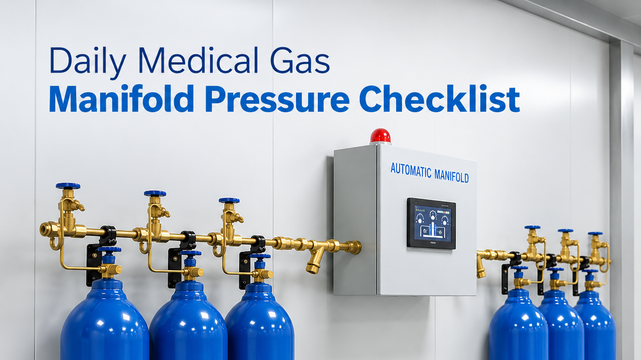
A hospital's medical gas cylinder manifold must be monitored every day to help maintain a continuous supply of oxygen and other prescribed medical gases to critical care units, operation theatres, ICUs and patient wards. Regular checks help staff identify falling cylinder pressure, an exhausted supply bank, abnormal pipeline pressure and alarm faults before they interrupt gas delivery.
For hospital maintenance teams, biomedical engineers and facility managers, a written medical gas cylinder manifold bank pressure monitoring checklist makes daily inspections more consistent and easier to document.
Randall Care provides medical gas equipment, including semi-automatic oxygen control panels for monitoring primary and reserve cylinder banks, as well as medical gas alarm systems for pipeline pressure monitoring.
Why Daily Manifold Pressure Monitoring Matters
A manifold connects cylinder banks to a hospital's medical gas pipeline system. Depending on the installed configuration, one bank supplies gas while the other remains available as a reserve. Pressure indicators and alarms help trained staff recognise when a supply bank needs attention.
Daily monitoring supports hospitals by helping them:
- Identify a cylinder bank approaching depletion.
- Confirm that primary and reserve bank pressure indicators are readable.
- Detect abnormal pressure readings or unexpected pressure drops.
- Check whether visual and audible alarms are functioning.
- Arrange cylinder replacement before the available supply becomes insufficient.
- Maintain inspection records for maintenance reviews and hospital safety audits.
Medical gas systems require continuous operational monitoring in addition to daily inspection. The World Health Organization's national and international medical gas guidance, applicable hospital procedures and the equipment manufacturer's instructions should inform the hospital's maintenance programme.
Daily Medical Gas Manifold Bank Pressure Monitoring Checklist
The following checklist is a general template for trained hospital engineering or biomedical maintenance personnel. Adapt it to the gas type, manifold design, alarm configuration and hospital SOP.
|
No. |
Inspection point |
What to verify |
Status |
|
1 |
Primary bank pressure |
Record the displayed pressure and compare it with the equipment's specified operating range and previous readings. |
Pass / Fail |
|
2 |
Reserve bank pressure |
Confirm that the reserve bank has sufficient pressure according to the hospital's approved reserve policy. |
Pass / Fail |
|
3 |
Cylinder availability |
Check the number of connected, available and depleted cylinders in each bank. |
Pass / Fail |
|
4 |
Cylinder security |
Verify that cylinders are secured upright and protected against falling or impact. |
Pass / Fail |
|
5 |
Cylinder connections |
Visually inspect accessible connections and flexible pigtails for damage, abnormal movement or visible signs of leakage. |
Pass / Fail |
|
6 |
Manifold valves |
Check that valves and controls are in their designated operating positions, following the approved procedure. |
Pass / Fail |
|
7 |
Changeover status |
Confirm the indicated active bank and reserve bank status match the actual system condition. |
Pass / Fail |
|
8 |
Pressure control panel |
Check gauges or digital displays for legibility, damage and abnormal indications. |
Pass / Fail |
|
9 |
Alarm indicators |
Check the panel for active, fault or low-pressure indications and follow the approved alarm-testing procedure. |
Pass / Fail |
|
10 |
Pipeline pressure |
Record the indicated delivery pressure and compare it with the specified range for the installed system. |
Pass / Fail |
|
11 |
General condition |
Check for obstruction, poor housekeeping, unauthorised access or visible damage around the manifold area. |
Pass / Fail |
|
12 |
Inspection record |
Record readings, exceptions, corrective action and the name of the person completing the inspection. |
Pass / Fail |
Important: Do not use a universal pressure value for every medical gas system. Acceptable readings depend on the gas, cylinder conditions, regulator configuration and system design. Use the approved limits documented for the installed equipment.
How to Record Cylinder Bank Pressure Correctly
A pressure reading is more useful when it can be compared with earlier readings. The hospital should use a standard log sheet or digital maintenance record for each manifold.
Record the following information during each scheduled inspection:
- Date and inspection time.
- Gas type and manifold identification.
- Primary bank pressure reading and unit displayed.
- Reserve bank pressure reading and unit displayed.
- Active bank and changeover status.
- Pipeline delivery pressure, where specified by the SOP.
- Alarm or fault indications.
- Cylinder replenishment or replacement required.
- Corrective action, escalation and staff initials.
Record the actual readings shown on the installed instruments. Do not estimate a value, change a reading to make it appear normal or mark a failed check as satisfactory.
What to Do When Pressure Is Abnormal
An unexpected pressure drop, low-bank indication or active alarm should be treated as an operational issue requiring prompt attention.
- Notify the responsible team: Inform the designated biomedical engineer, facility manager or medical gas system operator according to hospital procedure.
- Assess supply status: Trained personnel should establish which bank is active, whether reserve supply is available and whether clinical areas may be affected.
- Follow the approved response plan: Use the hospital's emergency procedure and the manifold manufacturer's instructions. Do not improvise a changeover or adjust regulators without authorisation.
- Escalate any supply risk immediately: If continuous gas delivery could be compromised, activate the hospital's medical gas emergency response and notify affected clinical teams.
- Document the incident: Record the readings, alarm status, time reported, actions taken and final resolution.
- Arrange technical inspection: A qualified service technician should investigate recurring pressure drops, suspected leaks, regulator problems or faulty alarms.
Never use an open flame to check for leaks. Do not dismantle pressurised connections or perform unauthorised repairs. Medical oxygen also creates a serious fire hazard when it comes into contact with oil, grease or incompatible materials.
Daily Pressure Checks vs. Routine Preventive Maintenance
Daily checks are only one part of a safe medical gas maintenance programme.
|
Maintenance activity |
Main purpose |
|
Daily monitoring |
Review bank pressure, supply status, alarms and visible equipment condition. |
|
Scheduled functional testing |
Verify alarm and changeover functions according to the approved maintenance plan. |
|
Preventive maintenance |
Have qualified personnel inspect regulators, valves, connections, gauges and related components at prescribed intervals. |
|
Periodic system testing |
Verify pipeline performance and safety in accordance with applicable standards and the manufacturer's requirements. |
|
Emergency readiness review |
Confirm staff responsibilities, escalation procedures and arrangements for alternative supply. |
Testing alarms may require a controlled procedure. Staff should not deliberately create a low-pressure condition on a live medical gas system unless the test is authorised, risk-assessed and carried out under the approved method.
What Should Hospitals Look for in a Medical Gas Monitoring System?
When reviewing manifold and monitoring equipment, hospital procurement and engineering teams should consider:
- Clear pressure indication: Gauges or displays should allow staff to identify readings and bank status easily.
- Suitable alarm provision: The system should provide the required visual and audible alerts for the installed configuration.
- Appropriate changeover arrangement: The selected control panel should match the hospital's primary and reserve bank design and operating procedure.
- Correct gas and pressure specifications: Equipment must be suitable for the particular gas service and intended operating conditions.
- Service and maintenance support: The supplier should be able to provide technical documentation, maintenance guidance and compatible replacement components.
- Compliance documentation: Confirm applicable standards, test records and technical specifications before procurement or installation.
Randall Care offers semi-automatic oxygen control panels, medical gas low-pressure alarm systems and other medical gas pipeline system components for healthcare facilities. The correct configuration should be selected according to the hospital's engineering requirements and clinical gas demand.
Printable Daily Manifold Pressure Monitoring Log
Hospitals can adapt this simple format to their approved maintenance documentation.
|
Record field |
Entry |
|
Hospital / department |
__________________ |
|
Manifold identification |
__________________ |
|
Gas type |
__________________ |
|
Date and time |
__________________ |
|
Primary bank pressure |
__________________ |
|
Reserve bank pressure |
__________________ |
|
Pipeline delivery pressure, if applicable |
__________________ |
|
Active bank / changeover indication |
__________________ |
|
Alarm or fault status |
__________________ |
|
Cylinder replacement required |
Yes / No |
|
Corrective action / escalation |
__________________ |
|
Inspected by |
__________________ |
|
Supervisor verification |
__________________ |
Use one record for each inspection as required by the hospital's schedule. Additional entries should be made whenever an alarm, cylinder replacement, pressure abnormality or maintenance intervention occurs.
Frequently Asked Questions
1. How often should a hospital check medical gas manifold bank pressure?
Hospital staff should follow the approved inspection schedule and SOP. Daily checks are a useful routine, while the manifold and pipeline system require continuous monitoring where provided, plus scheduled preventive maintenance and functional testing.
2. What pressure should a medical oxygen cylinder manifold maintain?
There is no single reading suitable for every system. The acceptable cylinder-bank and pipeline pressures depend on the equipment configuration and approved system specifications. Staff should use the documented limits for their installation.
3. What should staff do when the primary bank pressure falls?
Staff should follow the hospital's approved low-pressure and bank-changeover procedure, confirm reserve availability through the designated process and escalate any risk to continuous supply immediately. Only trained, authorised personnel should operate the manifold.
4. Why is a reserve cylinder bank necessary?
A reserve bank provides an alternative source when the primary bank is depleted or unavailable. Its capacity and readiness must be managed according to the hospital's gas demand, approved design and emergency supply plan.
5. What is the purpose of a medical gas low-pressure alarm?
A low-pressure alarm alerts responsible personnel when monitored pipeline pressure moves outside its configured limits. It provides an early warning so the team can investigate and respond before supply problems affect clinical areas.
6. Can a daily checklist replace preventive maintenance?
No. A checklist helps document routine observations, but it does not replace authorised testing, servicing, calibration where applicable, leak investigation or other maintenance required by the manufacturer and hospital procedures.
Improve Medical Gas Monitoring with Randall Care
Consistent pressure monitoring, clear alarm indications and documented maintenance procedures help hospitals manage their medical gas infrastructure more effectively. The checklist should be incorporated into the facility's own SOP and reviewed by the responsible engineering and clinical safety teams.
For medical gas manifold control panels, low-pressure alarms and related hospital gas pipeline components, visit Randall Care to review available equipment and discuss your facility's technical requirements.
A documented daily check is an important safeguard, but safe medical gas delivery depends on suitable equipment, continuous monitoring, trained personnel and a tested emergency response plan.